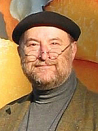
Fachwissen zu allen Erneuerbaren Energien

Prof. Dr. Ing. habil.  Werner Bidlingmaier

Bauhaus-Universität Weimar
Knoten Weimar


1486 Besucher auf diesem Profil
Sprachkompetenz:    
Nationalität:deutsch
Schwerpunkte: Abfallwirtschaft
Umfangreiche Veröffentlichungen und Organisator internationaler Veranstaltungen

Aktuelle Tätigkeit:Knoten Weimar c/o Bauhaus-Universität Weimar


Frühere Tätigkeit:- 1972 - 1993: Forschungs- und Entwicklungsarbeiten als Wissenschaftlicher Angestellter am Institut fur Siedlungswasserbau, Wassergüte- und Abfallwirtschaft, Abteilung Abfalltechnik, Universität Stuttgart. Ab 1976 dort stellvertretender Abteilungsleiter der Abteilung Abfalltechnik, ab 1989 Leiter der Abteilung Siedlungsabfälle
- 1991: Ernennung zum Privatdozenten an der Universität Stuttgart mit dem Lehrgebiet: "Siedlungsabfallwirtschaft"
- 1993 - 1997: Professor fur Abfallwirtschaft der Universität GH Essen
- 2001 - 2004: Prorektor fur Internationale Beziehungen an der Bauhaus-Universität Weimar
- 2003 - 2004: Prorektor fur Forschung an der Bauhaus-Universität Weimar
- Juli - November 2004: amtierender Rektor der Bauhaus-Universität Weimar
- bis 2012 Professur für Abfallwirtschaft an der Bauhaus-Universität Weimar

Ausbildung:- 1967 - 1972: Studium des Bauingenieurwesens an der Universitat Stuttgart; 2 Auslandssemester, Thema der Diplomarbeit: "Recycling in der Abfallwirtschaft"
- 1979: Promotion zum Dr.-Ing. an der Fakultät Bauwesen der Universität Stuttgart; Thema: "Faktoren zur Steuerung der gemeinsamen Kompostierung von Abwasserschlamm mit organischen Strukturhilfsmitteln"
- 1990: Habilitation an der Fakultät Bauwesen der Universität Stuttgart; Thema: "Schwermetalle im Hausmull"


Fachbeiträge: Bio-based polymer products - oppertunities and limitations from a disposal and recyclling perspective (6/2012)

Energieeffizienz der stofflichen und energetischen Verwertung ausgewählter Abfallfraktionen (4/2010)

Instrument zur Erstellung angepasster Deponiekonzepte für Entwicklungsländer (2/2010)

Die getrennte Sammlung von Bioabfall - Luxus oder ökologische / ökonomische Notwendigkeit? (9/2009)

Die Verantwortung der Abfallwirtschaft für den Klimaschutz (1/2009)

Open windrow composting manual (12/2008)

Organic waste management in the EC (11/2008)

Development of a software for forecasting the odour emissions from composting plants. (10/2008)

The RrRU-BMW project - 134 weeks pilot source separation of bioorganic municipal waste in Shenyang, China (10/2008)

History of organic waste management in the Kathmandu valley (10/2008)

Open windrow composting of gardening non-green waste and household fresh green waste of Lamphun City, Thailand (10/2008)

Future prospects of CDM framework to develop a sustainable landfill system in Bangladesh to replace open dumping (10/2008)

An integrated innovative project for sustainable production of bioethanol, methane and compost from sweet potato (10/2008)

Brauchen wir eine stoffliche Verwertung organischer Reststoffe? (9/2008)

Wohin mit den Rückständen aus der Biomassenutzung (2/2008)

PEOPLE AND WASTE: UNDERSTANDING THE REAL VALUE OF WASTE IN MORELOS, MEXICO (10/2007)

SAFE AND SUSTAINABLE MANAGEMENT OF MUNICIPAL SOLID WASTE IN KHULNA CITY OF BANGLADESH (10/2007)

DECISION GUIDANCE TO BUILD ALTERNATIVE LANDFILL CONCEPTS FOR MIDDLE AND LOW INCOME COUNTRIES (10/2007)

DEVELOPING A SET OF DEVICES FOR CREATING AN EMISSION PROGNOSIS FOR PLANNING A COMPOSTING PLANT (10/2007)

Biogas from Municipal and Agricultural Bioorganic Waste: Renewable Energy for China (5/2007)

Pilot research on source separation and utilisation of bioorganic municipal waste (BMW) in China (9/2006)

"World wide movement of organic matter - a South- North one-way flow?" (9/2006)

Integrated sustainable decentralised bio-waste utilisation approach in Thailand (9/2006)

Developing a set of devices for creating an emission prognosis for planning a composting plant (9/2006)

Development of a model for an Integrated Urban Management Plan on example of the Thai City Lamphun (9/2006)

Persepktiven der Deponieabdichtung als Lösungen für Deponien in Entwicklungs- und Schwellenländern (5/2006)

Management of Municipal Solid Waste in China - Mechanical Biological Treatment can be an Option? (11/2005)

Auswirkungen der TA Luft auf die Bioabfall-Behandlung (5/2005)

Recovery and Recycling Paths of Biodegradable Polymer Packaging - Case Study Kassel City - (4/2005)

Stand der Technik für Kompostwerke (12/2004)

Großes Potential (7/2004)

Ferngesteuerte Hilfe (7/2004)

Suche nach neuen Antworten (7/2004)

Globale Aspekte der biologischen Abfallbehandlung (3/2004)

Products From Waste - an Industrial Perspective (3/2004)

Test methods for characterisation of the biological stability of pretreated MSW (5/2003)

The Kassel Project - Use and recovery of biodegradable polymer packaging (5/2003)

An innovative low cost technology for the purification of low polluted landfill leachate consisting of compost filter and constructed wetland (5/2003)

Backyard or home composting of biodegradable polymer packaging (5/2003)

Hydrolysis rate of solid waste as a parameter for process control of digesters (5/2003)

Fuzzyfying the composting process - a new model based control strategy as a device for achieving high grade and consistent product quality (5/2003)

International partnerships for south africa’s development – an implementation strategy for sustainable development (5/2003)

The shortening and optimisation of the start up stage – a great challenge for anaerobic digestion technology of the future (5/2003)

Kompostierbare Verpackungen - Konsequenzen für die Bioabfallsammlung am Beispiel des BAW - Modellprojektes Kassel (11/2002)

Der globale Markt erfordert individuelle Lösungen (8/2002)

Test unter Praxisbedingungen (8/2001)

Biodegradable materials: Analysis of their relevance to waste management (9/2000)

Breite, sichere Anwendungsbasis (8/1998)

Login

ASK - Unser Kooperationspartner


Unsere content-Partner
zum aktuellen Verzeichnis


Unsere 3 aktuellsten Fachartikel

Europäische Rechtsvorgaben und Auswirkungen auf die Bioabfallwirtschaft in Deutschland
© Witzenhausen-Institut für Abfall, Umwelt und Energie GmbH (11/2025)
Bioabfälle machen 34 % der Siedlungsabfälle aus und bilden damit die größte Abfallfraktion im Siedlungsabfall in der EU. Rund 40 Millionen Tonnen Bioabfälle werden jährlich in der EU getrennt gesammelt und in ca. 4.500 Kompostierungs- und Vergärungsanlagen behandelt.

Vom Gärrest zum hochwertigen Gärprodukt - eine Einführung
© Witzenhausen-Institut für Abfall, Umwelt und Energie GmbH (11/2025)
Auch mittel- bis langfristig steht zu erwarten, dass die Kaskade aus anaerober und aerober Behandlung Standard für die Biogutbehandlung sein wird.

Die Mischung macht‘s - Der Gärrestmischer in der Praxis
© Witzenhausen-Institut für Abfall, Umwelt und Energie GmbH (11/2025)
Zur Nachbehandlung von Gärrest aus Bio- und Restabfall entwickelte Eggersmann den Gärrestmischer, der aus Gärresten und Zuschlagstoffen homogene, gut belüftbare Mischungen erzeugt. Damit wird den besonderen Anforderungen der Gärreste mit hohem Wassergehalt begegnet und eine effiziente Kompostierung ermöglicht.